
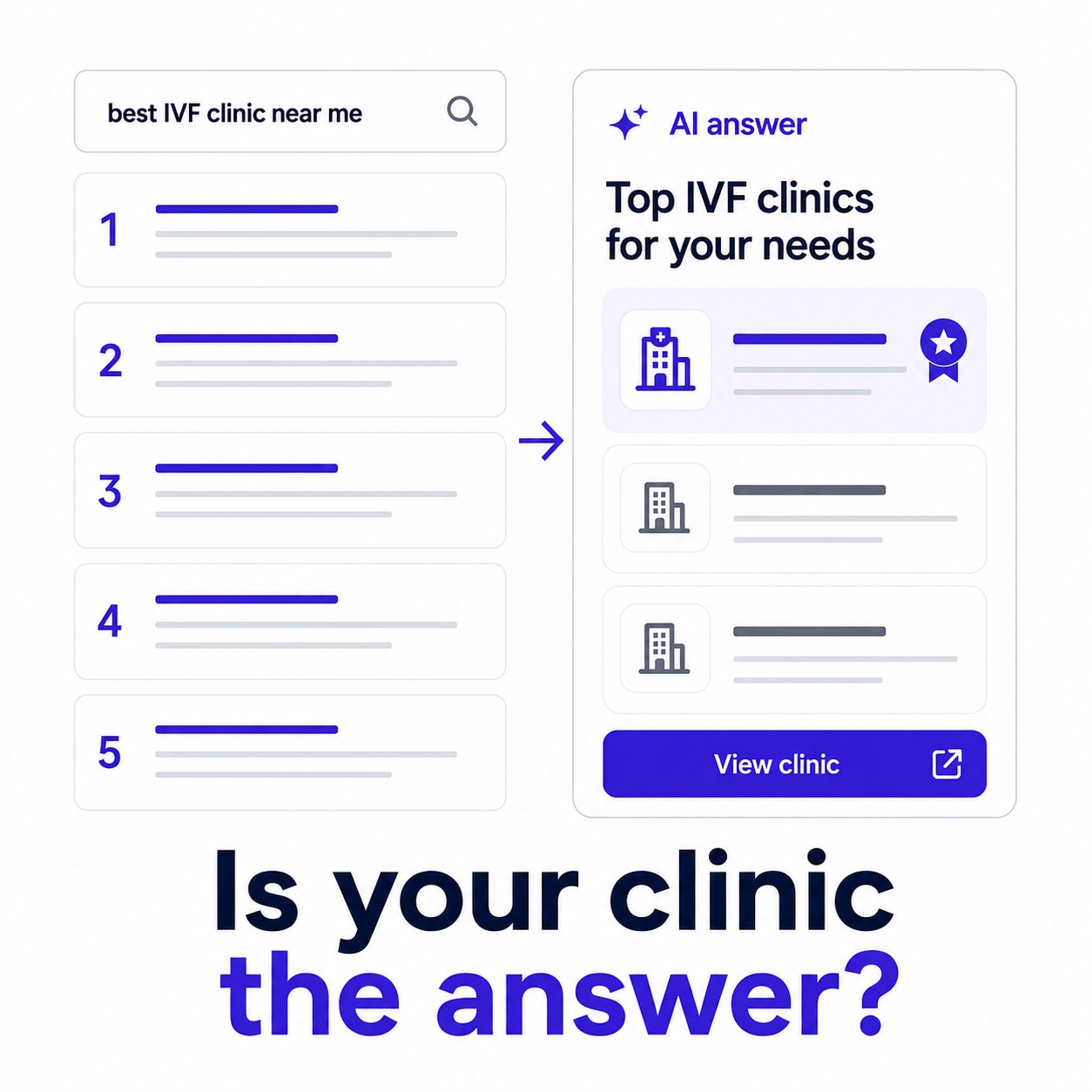
AI Search for IVF Clinics: From Ranking to Recommended
Optimizing a fertility clinic for AI search requires shifting focus from traditional keyword rankings to becoming a cited entity that answer engines trust and recommend. Clinics achieve this visibility by publishing deep content hubs that provide specific answers to complex patient questions regarding costs, success rates, and specialized protocols while maintaining clear technical signals like medical review dates and consistent provider data.
Ranking for keywords no longer guarantees that patients find you. If AI systems do not understand when to cite or recommend your clinic, you can hold the top organic spot and still be absent from the answer a prospective patient actually reads. AI search for fertility clinics has moved the contest from "which page ranks" to "which clinic gets named."
Patients now research fertility care inside ChatGPT, Gemini, Perplexity, and Google AI Overviews before they ever land on your site, and the clinics named in those answers earn a disproportionate share of high-intent consultations. By the end of this article, you will know what AI search rewards, which patient questions to become the trusted answer for, and how to connect that visibility to booked consults.
Key Takeaways
- AI search raises the bar; it does not replace SEO - Helpful, reliable, specific, entity-clear content still wins, now with higher standards.
- Fertility is highly exposed - Long, high-consideration research journeys mean AI answers compress a shortlist, and outdated info can cost you the recommendation.
- Specificity gets cited - Clarity by service line, location, patient situation, and decision stage helps AI parse and trust your clinic.
- Build deep hubs, not thin posts - IVF, egg freezing, donor egg, cost, success proof, doctors, and locations, all answering real decision questions.
- Visibility must convert - A citation means nothing if the patient never reaches a consult.
What Changed: Search Is Becoming Answer-Led
Search is shifting from a list of ten blue links to a synthesized answer you can ask follow-up questions about. AI Overviews sit at the top of Google results and summarize an answer, while AI Mode lets users hold a back-and-forth conversation. ChatGPT, Gemini, and Perplexity work the same way as standalone answer engines, pulling from sources and naming a few they trust.
The scale is real. Google's AI Overviews reach over 2 billion monthly users, as Digiday reported, and ChatGPT reached 900 million weekly active users, according to TechCrunch. Healthcare visibility is moving from only ranking pages to being cited, summarized, and recommended.
This does not mean SEO is dead. AI systems still favor helpful, reliable, entity-clear content, and no tool exposes a single transparent ranking formula. The bar for quality simply went up.
Why Fertility Clinics Are Exposed
Fertility care is one of the most affected categories because patients research widely over a long window, often weighing several clinics on cost, success rates, doctor trust, and emotional fit. AI answers compress that sprawling research into a short list, and the clinics that get named gain an outsized advantage.
That compression cuts both ways. If your services, locations, doctors, or costs appear incorrect, outdated, or thin, an AI answer can repeat the error or cite a competitor instead. Because fertility queries are high-consideration and high-lifetime-value, losing that recommendation carries a real revenue impact per patient.
Health content also raises the trust threshold. AI systems lean heavily on visible expertise and Experience, Expertise, Authoritativeness, and Trustworthiness (E-E-A-T) signals, which many clinic sites underinvest in. Credentials, review dates, and reputable citations are not decoration here; they are how you earn the mention.
What AI Tools Need to Understand About Your Clinic
AI systems often work at the answer, passage, entity, service, provider, and location level, not just the page-title level. So the details about who you are and what you offer must be explicit and consistent everywhere they appear.
Entity clarity is the foundation. Use consistent service names, complete location details, and clear doctor and embryology team information that a machine can parse and trust across your site, your listings, and reputable third-party profiles.
Beyond clarity, specificity is what earns the citation. Content that speaks precisely to a service line, a location, a patient situation, and a decision stage gives AI a confident reason to surface you, alongside medically responsible framing. Google's public guidance still rewards helpful, reliable, people-first content, so the goal is genuine usefulness, not tricks.
The Patient Questions That Matter
AI-era queries are longer and more specific than old keyword searches, combining location, service, patient context, proof, and trust in a single prompt. Someone no longer types "IVF clinic," they ask which clinic explains financing clearly for a woman over 40 near them.
These are the questions you want to become the trusted answer for. Many mirror the "People Also Ask" phrasing that snippets and AI Overviews pull from, so answering them plainly helps on both surfaces.
The Content Hubs to Build
Depth and structure win in AI search, so build a few deep, citation-ready hubs rather than dozens of thin posts. Each hub should thoroughly answer a real patient decision question and connect to a clear next step.
Prioritize these hubs:
- Core treatments - IVF, egg freezing, donor egg, and male factor infertility.
- Decision moments - Second opinion after failed IVF, plus age and diagnosis decision hubs.
- Money and proof - Cost, insurance, financing, and refund explanations, alongside success rates and proof.
- Entity and place - Doctor and embryology team pages, and location pages with real local service detail.
- Choosing help - Patient-decision FAQ pages and responsible comparison pages.
Use original clinic data only when it is approved and accurate. Then link intentionally across service, provider, location, cost, and next-step pages so both patients and AI can follow the path from question to consult.
Technical and Trust Signals That Make Content AI-Readable
Lead each section with a direct, self-contained answer that an AI can quote. Clear H1 and H2 structure, short answer blocks near each question, FAQ sections, and schema, where appropriate, all help systems parse and lift your content cleanly.
Trust signals matter just as much for health content. Show provider credentials, add review or "last updated" dates, mark content as medically reviewed where needed, and cite reputable sources such as the CDC, SART, or ASRM where relevant.
Consistency ties it together. Keep service and location names identical across pages, and connect service, provider, location, cost, and next-step pages with internal links. Write in natural, conversational phrasing that matches how patients actually ask, with no keyword stuffing.
How to Audit Your AI Visibility
Run a repeatable audit using a fixed set of patient prompts, then capture screenshots and re-run it over time, because AI answers change frequently. This gives you evidence, not guesswork, about where you stand.
Following this audit will not guarantee citations or rankings. It will show you, with evidence, where clarity and depth are missing so you can fix the gaps that matter most.
Connecting AI Visibility to Patient Movement
AI visibility must connect to conversion and patient movement, not only mentions. Being named in an answer means nothing commercially if the patient never reaches a consult, so treat the citation as the start of the journey rather than the win.
When patients arrive from an AI answer, the site path should preserve the reason they came, whether that is treatment interest, a cost concern, second-opinion context, or a specific location, and route them to a relevant next step. A generic homepage drops that context and loses the patient.
This is where Irresist helps, and not as a generic SEO agency. Irresist connects AI and search intent to route-specific next steps, before-inquiry conversion, and consult movement. It deploys focused patient journeys dynamically by inferring the visitor's likely job-to-be-done, then serving the most relevant module and tracking forms, calls, and key actions with controlled measurement.
What To Do Next
Becoming the answer patients trust is won by clarity, depth, and proof, not by chasing tricks that promise citations no one can guarantee. Pick your three highest-value patient questions, run the audit prompts across Google AI Overviews, ChatGPT, Gemini, and Perplexity, and note where you are cited, where a competitor is, and where the answer is simply wrong.
Then close the loop from visibility to booked consults. Request an AI visibility and Revenue Leak Map review from Irresist to see which patient questions your clinic should become the answer for, and whether the resulting demand can actually be captured and measured.
FAQ
How can a fertility clinic show up in ChatGPT recommendations?
Build clear, specific, trustworthy content around the real questions patients ask, then make it easy to parse with direct answer blocks, consistent entity details, and visible credentials. Answer by service line, location, and patient situation rather than in vague generalities. No tool can guarantee a ChatGPT fertility clinic recommendation, since answer engines change and do not expose a fixed formula.
How should IVF clinics optimize for Google AI Overviews?
Focus on helpful, people-first content that leads each section with a direct, self-contained answer an AI can quote. Strengthen entity clarity, and E-E-A-T signals with provider credentials, review dates, and citations to sources like the CDC, SART, or ASRM. Avoid overclaiming ranking mechanics, and treat Google AI Overviews healthcare SEO as raising the quality bar rather than offering a shortcut.
What content does a fertility clinic need for AI search?
Build deep, citation-ready hubs for IVF, egg freezing, donor egg, male factor, second opinion, cost and financing, success proof, age and diagnosis, doctors, and locations, plus decision FAQs and responsible comparison pages. Support them with AI-readable signals: clear headings, short answer blocks, FAQ sections, schema, credentials, review dates, and internal links across service, provider, location, and cost pages.
Does AI search replace fertility clinic SEO?
No. AI search does not replace fertility clinic SEO, it raises the bar. The same fundamentals of helpful, reliable, specific, entity-clear content still matter, and now they must be clearer and better structured. Answer engine optimization for medical practices builds on solid SEO, it does not discard it.
How do I audit whether AI tools recommend our clinic?
Run a fixed set of patient prompts across ChatGPT, Gemini, Perplexity, and Google AI Overviews, and record whether you, a competitor, or incorrect information appears. Capture screenshots and re-run the set over time, because AI answers shift. Also, check that your services, doctors, costs, and proof read clearly, and that the content connects to conversion tracking.
Why isn't AI visibility enough on its own?
A mention only matters commercially if it turns into a consult. If patients arrive from an AI answer and hit a generic page that ignores why they came, the visibility leaks away. Connecting AI and search intent to route-specific next steps and measured consult movement is what makes GEO for healthcare pay off.