
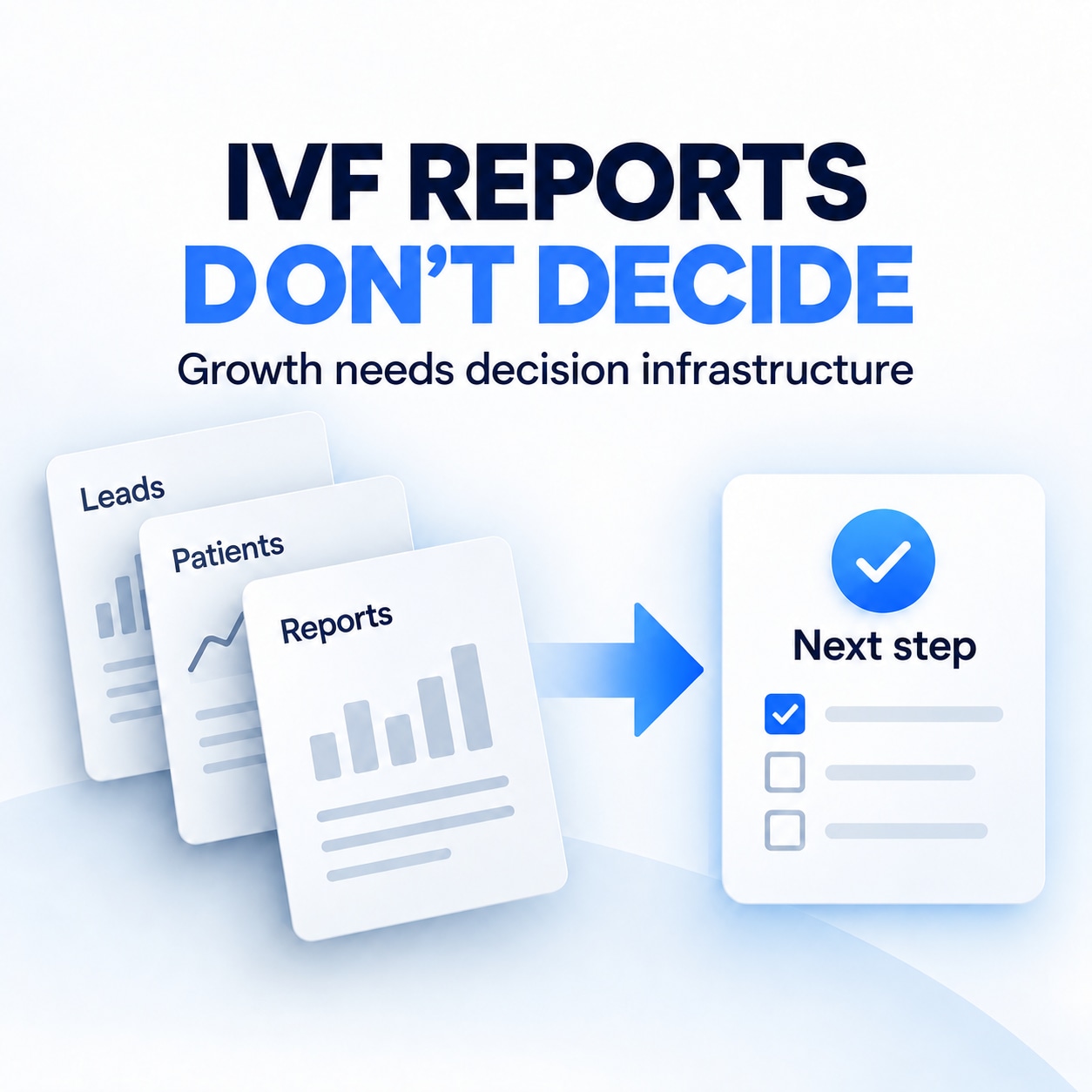
Why Fertility Clinics Need Decision Infrastructure, Not Just Reporting
Fertility clinics transition from basic reporting to decision infrastructure by shifting their focus from historical data summaries to actionable systems that identify specific changes and owners. This framework requires connecting movement metrics with patient context and data confidence to ensure that every growth meeting results in a named intervention with a clear review date.
It's Monday at 9:00 AM, and the growth deck looks full. It shows leads, cost per lead, and traffic by channel. Then someone asks what the team will change this week, and nobody has an answer. Fertility clinic analytics that only recount history leave growth teams guessing, even when the charts are clean.
This piece is for clinic leaders, operators, and analytics-minded marketers who already get plenty of numbers but still can't tell what to change next. It covers four things. First, how reporting differs from decision infrastructure. Second, the four connections a useful system makes. Third, the warning signs that you only have reporting. Last, a checklist you can run in your next meeting.
Key Takeaways
- Reporting looks backward - It tells you what happened. Decision infrastructure names the next change, its owner, and the metric that will show whether it worked.
- Four links have to hold - The system needs metrics, context, confidence, and action. If any one is missing, the system stops being useful.
- Movement beats volume - Track booked consults, attended consults, and starts as separate stages. Don't fold them into one conversion rate.
- Fertility needs a stricter standard - Patient trust, finite capacity, consent limits, and public success-rate rules all raise the bar.
- You don't need new software to start - The gaps you find become your work list.
Fertility Clinic Analytics Versus Decision Infrastructure
Fertility clinic reporting describes activity or results after they happen. Decision infrastructure is built so a named person can change a specific part of the patient path. Reporting answers what happened. Decision infrastructure answers what should change, who owns that change, and how the team will know it worked.
That's why spending more on IVF business intelligence doesn't fix the problem on its own. A polished BI stack is still just a better-looking report if no one acts on what it shows. The table below compares the two across six dimensions.
In your next growth meeting, go through every slide and ask which column it belongs in. If the whole deck sits in the left column, you have reports and no next move. A common sign of this is measurement that stops at traffic instead of tracking to consultations.
How Good Systems Connect Metrics, Context, Confidence, and Action
A useful system breaks down when any one of these four links is missing. Fertility clinic data infrastructure is the plumbing that keeps all four tied to the same patient record.
Start With Movement Metrics
Keep these stages separate: inquiry, contacted, booked consult, attended consult, no-show, cancelled or postponed, lost, and treatment start, if the clinic can see it. If you collapse them into one conversion rate, you can't tell where patients are dropping off. Sessions, form fills, scans, and cycles started can all go up while the clinic is commercially stuck. Where consent and your systems allow, phone and form inquiries should update the same patient status.
Add the Context Behind the Number
Every growth decision needs context. That includes the patient's original reason for reaching out, treatment interest, urgency, cost or insurance concerns, whether they want a second opinion or have had a failed cycle, channel, location, and what's stopping them right now. Take 20 booked consults. If they're mostly from patients worried about cost, the next step is financing clarity. If they're mostly from patients ready for treatment, the next step is protecting the appointment. This context has to survive the handoff from marketing to intake. A note that says "called, no answer" isn't context.
Label Confidence Before You Act
Use three labels:
- Measured - The event was recorded, like a booked consult logged in the scheduling system.
- Inferred - The conclusion was reasoned from other signals, like guessing a patient's intent from the pages they read.
- Missing - The data doesn't exist, like the outcome of a phone inquiry nobody logged.
A proof boundary is the limit of what your evidence can show. Comparing leads before and after a change is weaker evidence than comparing against a holdout group that never saw the change. Likewise, a lost reason logged on only some records can't explain every inquiry that didn't book. Incomplete data is a finding in its own right. The mistake is letting a clean chart hide the gap, which is why conversion KPIs need a confidence layer.
Name the Action and the Owner
A complete action has four parts: a change, an owner, a review date, and the movement metric that will confirm or reject it. Say high-intent inquiries wait too long for first contact. The intake lead tightens the callback window, and the team checks contacted-to-booked movement in two weeks. Or say booked consults aren't being attended and nobody tracks recovery. A coordinator adds a recovery status, and the team reviews attendance next month. A monthly PDF that changes no one's behavior is still reporting. A weekly loop with a monthly review gets much closer to infrastructure. The Conversion Leakage Model maps where patient movement stops.
Why Healthcare and Fertility Need a Higher Standard
Healthcare analytics strategy in fertility has to be stricter than a typical marketing dashboard. A wrong growth decision costs more than ad spend. It can damage patient trust, strain clinical capacity, and draw public scrutiny.
The stakes are higher for several reasons. Patient timelines are long and emotional. Decisions involve several parties: the patient, a partner, a payer or the patient's own budget, the physician, and the lab. Privacy and consent rules limit what data you can join or automate. Health claims are held to a high standard of accuracy, so the numbers have to be right. In this article, IVF decision making means growth and operations choices only. It doesn't cover clinical protocol tools, stimulation dosing, or embryo selection.
Denominators matter too. A denominator is the number a percentage is calculated against, such as all started cycles or all embryo transfers. Starting with the 2011 ART Fertility Clinic Success Rates Report, ART success rates for patients using their own eggs were presented per cycle, per transfer, and per pregnancy, according to CDC's NASS technical notes, and they are stratified by age band. Reviewers enforce this. A study of SART advertising compliance in F&S Reports lists lack of denominators (cycle, retrieval, transfer) among its examples of noncompliant data. ASRM's social media guidance says providers must provide accurate and transparent information and avoid misrepresenting or overestimating important metrics such as pregnancy success rates. Your internal growth deck shouldn't be looser than the public standard your clinic is judged by.
Capacity matters as well. More inquiries can overload coordinators, retrieval days, or lab flow if the team can't see which demand will attend and start treatment. When retrieval load is uneven, scheduling and growth decisions need the same view of the data.
Signs You Have Reporting Without Decision Infrastructure
Here's a quick test. If leaders can describe last month but still can't name the next change, the clinic has reporting without decision infrastructure. Each sign below blocks a specific decision:
- The report stops at leads, sessions, or cost per lead - You can't see where movement stalls.
- Marketing and intake define "consult" differently - You can't agree on what improved.
- Phone and form inquiries never share a status - You can't fix the path most patients use.
- There's no lost reason or current barrier - You can't choose the right fix.
- A weak month brings another chart and the same actions - Nothing gets tested.
- Nobody can say which source produced attended consults or starts - You can't move budget with confidence.
- Success-rate slides lack age band or denominator notes - You risk claims that wouldn't pass public review.
- Confidence goes unstated - Partial data gets treated as proof.
- "Optimization" is a slide title - There's no owner and no way to tell whether a change worked.
Your monthly clinic growth reporting can look complete and still fail this test. Adding more tools won't help if the new tool just refreshes the same unanswered question.
Leadership Checklist
You can run this checklist in one meeting without buying software first:
- Name the decision this period's numbers are supposed to change.
- Track inquiry, contacted, booked, attended, no-show or cancelled, lost, and treatment start as separate stages.
- Keep the patient's original reason for reaching out attached through every follow-up.
- Label each growth claim as measured, inferred, or missing.
- Give the next change an owner and a review date.
- Check physician, coordinator, and lab capacity before chasing more volume.
- Ask what the team would stop doing if movement data disagreed with the lead report.
- Require a weekly review in addition to the monthly PDF.
Treat this as a starting standard. It doesn't assume every clinic can measure every stage today. Any stage you can't measure yet goes on your work list.
The Bottom Line
If your numbers don't name a next change, a fix owner, and a way to check the result, you have reports and not decision infrastructure. Run the checklist this week and pick the one change it points to. Then put a review date on the calendar before you leave the room.
That's the gap Irresist works on. We build decision infrastructure for clinic growth teams, not vanity reporting. That means tracking forms, calls, and key actions as patient movement, testing uplift with controlled measurement, and running a weekly optimization loop with a monthly performance review. The aim is for every Monday meeting to end with a change someone owns.
FAQ
What is fertility clinic analytics supposed to do?
Fertility clinic analytics should help the team decide the next change. To do that, it has to connect a movement metric, the patient context behind it, a confidence label, and an action with an owner.
How is decision infrastructure different from fertility clinic reporting?
Reporting records what already happened. Decision infrastructure assigns the next move: what changes, who owns it, and which metric will show whether it worked.
What should clinic growth reporting include beyond leads?
It should track contacted, booked, attended, no-show or cancelled, lost, and treatment start as separate stages. Attended consults and starts matter more than lead volume because they show whether demand turns into patients the clinic can treat.
Why does healthcare analytics strategy need a higher standard in fertility?
Growth mistakes in fertility affect patient trust and finite clinical capacity. Consent rules limit what data can be joined, and public success-rate reporting already sets strict expectations for denominators and age bands. Internal numbers should be held to the same care.
How can a clinic tell it has dashboards but not decision infrastructure?
Look for these signs:
- The report stops at leads.
- Phone and form inquiries never share a status.
- There's no lost reason on the record.
- Nobody owns the next change.
Does this require replacing the IVF EMR or buying a new BI tool?
No. Start by joining the records you already have and labeling what's missing. Irresist works alongside your existing systems as decision infrastructure for growth teams. It isn't an EMR and doesn't replace one.