
CPL vs CPA vs Patients per 100 Leads: What Fertility Clinics Should Actually Track
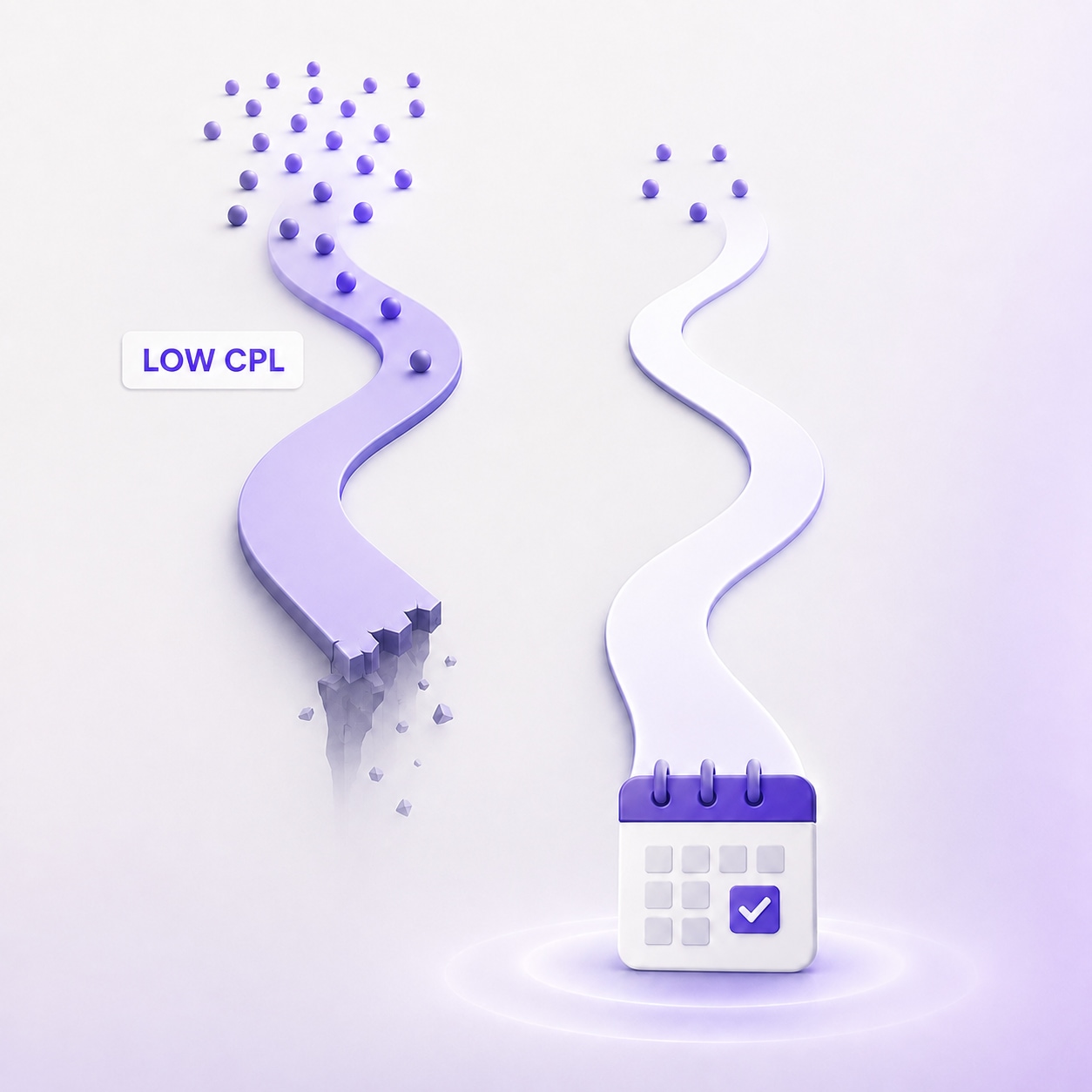
Fertility clinics should prioritize tracking patients per one hundred leads because cost per lead often masks the true expense of low quality inquiries that fail to convert into cycles. By measuring downstream movement from initial contact through treatment start, clinics can identify which marketing sources actually drive revenue rather than just generating high volumes of cheap form fills.
The cheapest lead source on your dashboard can quietly become the most expensive one you buy. You just can't see it until you follow the patient past the form fill, through the booked consult, into the exam room, and toward a treatment start.
If you buy or report on lead-gen performance and keep wondering why a low fertility clinic CPL never turns into consults or cycles, you're reading the right piece. We'll define CPL, CPA, and the stage metrics that sit between them, then show a simple way to rank sources by patient movement instead of lead price - so you can defend budget decisions with something better than the cheapest number on the sheet.
Key Takeaways
- CPL is a starting point, not a verdict - Cost per lead measures how cheaply you created a lead, not whether that lead becomes a patient.
- Define CPA before you compare it - The "A" can mean appointment, acquisition, or patient, so clinics and agencies often argue past each other.
- Patients per 100 leads exposes source quality - It forces you to count downstream movement: contacted, booked, attended, and treatment-started.
- Segmentation keeps you honest - Blended numbers hide the truth; compare by source, service line, location, channel, and time to first contact.
- Coverage beats precision - A metric is only as trustworthy as the lifecycle data behind it, so show the gaps instead of hiding them.
Why CPL Became the Default Metric
Cost per lead won by being convenient. It's available on day one, it needs no downstream data, and every ad platform reports it by default the moment your campaign spends a dollar.
That convenience is why CPL became the number agencies optimize toward, and clinics approve budgets against. It's fast, it's comparable across channels, and it fits neatly into a monthly report.
CPL earns its place for early channel efficiency - it's a fair read on whether a campaign can generate interest at a sane price. The trouble starts when it stands alone. A metric that's easy to measure is not the same as a metric that predicts patients.
Defining the Metrics: CPL, CPA, and Cost per Stage
Cost per lead is marketing spend divided by the number of leads. Cost per booked consult is spend divided by booked consults, cost per attended consult is spend divided by attended consults, and cost per treatment start is spend divided by treatment starts where that data exists. Patients per 100 leads answers a different question entirely: out of every 100 leads from a source, how many become a meaningful downstream outcome?
Define patient carefully, and state your definition every time you use it. Depending on your data maturity, a "patient" might mean an attended consult, a qualified booked consult, or a treatment start - and a report that shifts silently between those meanings is worse than no report at all.
Why CPA Must Be Defined Before You Compare It
Fertility clinic CPA is ambiguous because the "A" is a moving target. It can mean appointment, acquisition, or patient, and clinics and agencies routinely mean different things by the same three letters.
When you compare two CPA figures built on different definitions, you get false conclusions and misallocated budget. One party counts a booked consult as an acquisition; the other counts only a treatment start—same word, wildly different denominators, and a comparison that quietly lies to everyone in the meeting.
The fix is unglamorous and effective: agree on one written definition of "A" across the clinic and every agency, then label every report with the exact stage it measures.
Why CPL Misleads When Downstream Movement Is Missing
CPL rewards the volume of leads, not the quality of patients. A source can win on CPL and lose badly on outcomes, and you'd never know from the top-line number.
Here are the situations where cost per lead quietly misleads:
- A source generates plenty of low-intent leads that never progress.
- Patients submit forms but never respond to follow-up.
- Phone leads are missing from the count, inflating one channel's apparent efficiency.
- A higher-CPL source actually produces better attended consults.
- One channel creates education-stage leads while another creates treatment-ready ones.
- Cost concerns or second-opinion intent are never captured.
- Downstream status is missing entirely.
- Leads are counted in one period while treatment starts land in a later one.
None of this means low CPL is bad or high CPL is good. CPL alone simply cannot answer the source-quality question - that's the whole point.
The Patients per 100 Leads View
Patients per 100 leads makes IVF source quality visible without demanding perfect attribution on day one. The logic is a cohort: for every 100 leads from a source, count how many were contacted, booked, attended, and treatment-started, and how many were lost, no-show, or cancelled.
These figures are illustrative. In this example, Source A might carry the lower CPL yet delivers roughly half the attended consults and treatment starts of Source B. Wherever the data exists, the model should show contacted, booked, attended, no-show/lost, and treatment-start movement - not just the endpoints.
One caution: don't call this same-lead cohort proof unless your data actually follows the same leads through each stage. If you're stitching together period totals, describe it as that, honestly.
How to Compare Channels Without Lying to Yourself
A single blended number hides the truth by averaging strong and weak sources into one comfortable figure. Segmentation is the discipline that makes comparison honest.
Compare your leads across these dimensions:
- Source, medium, and campaign - Where the lead genuinely came from.
- Service line (Patient's problem/need) - IVF, IUI, egg freezing, donor eggs, male factor, or second opinion.
- Location - Movement varies by clinic and market.
- Route or landing page - The path the lead traveled.
- Channel - Phone, form, scheduler, chat, or email.
- First reason or barrier - What the patient actually wanted or feared.
- New versus returning patient - Different economics entirely.
- Time to first contact - How fast someone followed up.
Time to first contact deserves special attention, because slow follow-up can make a genuinely good source look weak. Before you rank anything, check coverage: missing phone leads or missing external outcomes can invalidate the entire comparison.
What Data Must Be Connected
Patients per 100 leads is only as trustworthy as the lifecycle data behind it, so the clinic has to connect lead capture to downstream status. That means preserving and linking source, first reason, and route, then carrying status through booked, attended, lost, no-show, and treatment start.
Where coverage is incomplete, show the gap next to the metric rather than hide it. The number grows more credible as your lifecycle data improves - and pretending to certainty you don't have only erodes trust with finance.
Run any source through this source-quality checklist:
- Is patient defined and stated on the report?
- Are phone leads included in the count?
- Is downstream status captured through treatment start?
- Is the data segmented by source and service line?
- Is time to first contact tracked?
- Is the denominator complete enough to trust?
- Are results from the same period, or better, the same lead cohort?
The CEO Question: Which Source Produces Patient Movement?
The leadership question isn't "which source is cheapest." It's "which source produces the most patient movement per 100 leads." That reframe changes what you fund and what you defend to the board.
This is where Irresist Recovered Revenue helps clinics move past CPL. It compares sources by booked, attended, lost, no-show, and treatment-start movement, preserves source, reason, route, and status, and surfaces where lead quality is simply unknown because data coverage is incomplete. The honesty stance matters most here: it avoids declaring a source good or bad without denominator confidence.
What To Do Next
Stop approving channels on cost per lead alone and start ranking them by patients per 100 leads - even a rough cohort beats a precise CPL that predicts nothing. Pick your two biggest sources this week, agree on one written definition of patient, and map their movement from contact to treatment start, marking every stage where your data has gaps.
If you want a clearer view of whether your best source is judged by lead price or patient movement, request a Revenue Leak Map or source-quality review from Irresist to compare channels by the movement that actually produces cycles.
FAQ
Should our fertility clinic optimize for CPL or booked consultations?
CPL is fine for judging early channel efficiency, but it can't tell you whether a source produces revenue. Booked and attended consults, expressed as patients per 100 leads, predict paying patients far better. Track both, and let downstream movement settle any budget disagreement.
What is a better metric than CPL for fertility clinics?
Patients per 100 leads is the clearest first metric, paired with cost per attended consult and cost per treatment start where that data exists. State the definition of each outcome every time you report it, since "patient" can mean an attended consult, a qualified booking, or a started cycle.
How do I compare lead quality across IVF marketing channels?
Segment by source and service line, then track how leads move through contacted, booked, attended, and treatment-started stages. Before ranking anything, check your data coverage - missing phone leads or external outcomes can invalidate the comparison entirely.
Why does CPA cause confusion between clinics and agencies?
The "A" in CPA can mean appointment, acquisition, or patient, and each party often assumes a different one. That mismatch produces false comparisons and misallocated budget. Agree on a single written definition and label every report with the stage it measures.
Is a low CPL source always the best choice?
Not necessarily. A cheap source can produce plenty of low-intent leads that generate fewer attended consults and treatment starts than a pricier one. Low CPL isn't automatically bad, and high CPL isn't automatically good - only downstream movement tells you which source actually works.
How do I know which source produces real patients?
Follow the same leads downstream wherever your systems allow, counting how many reach attended consults and treatment starts. Where coverage is incomplete, show the data-confidence limits next to the metric rather than overclaiming. Confidence grows as your lifecycle data improves.