
The Revenue Impact of Patient Leakage in IVF Clinics
IVF patient leakage is the loss of potential revenue occurring when reachable patients drop out of the care journey due to avoidable friction such as slow response times or unclear next steps. Clinics can mitigate this financial drain by identifying specific conversion gaps between inquiry and treatment to ensure that high value leads do not stall or exit the funnel prematurely.
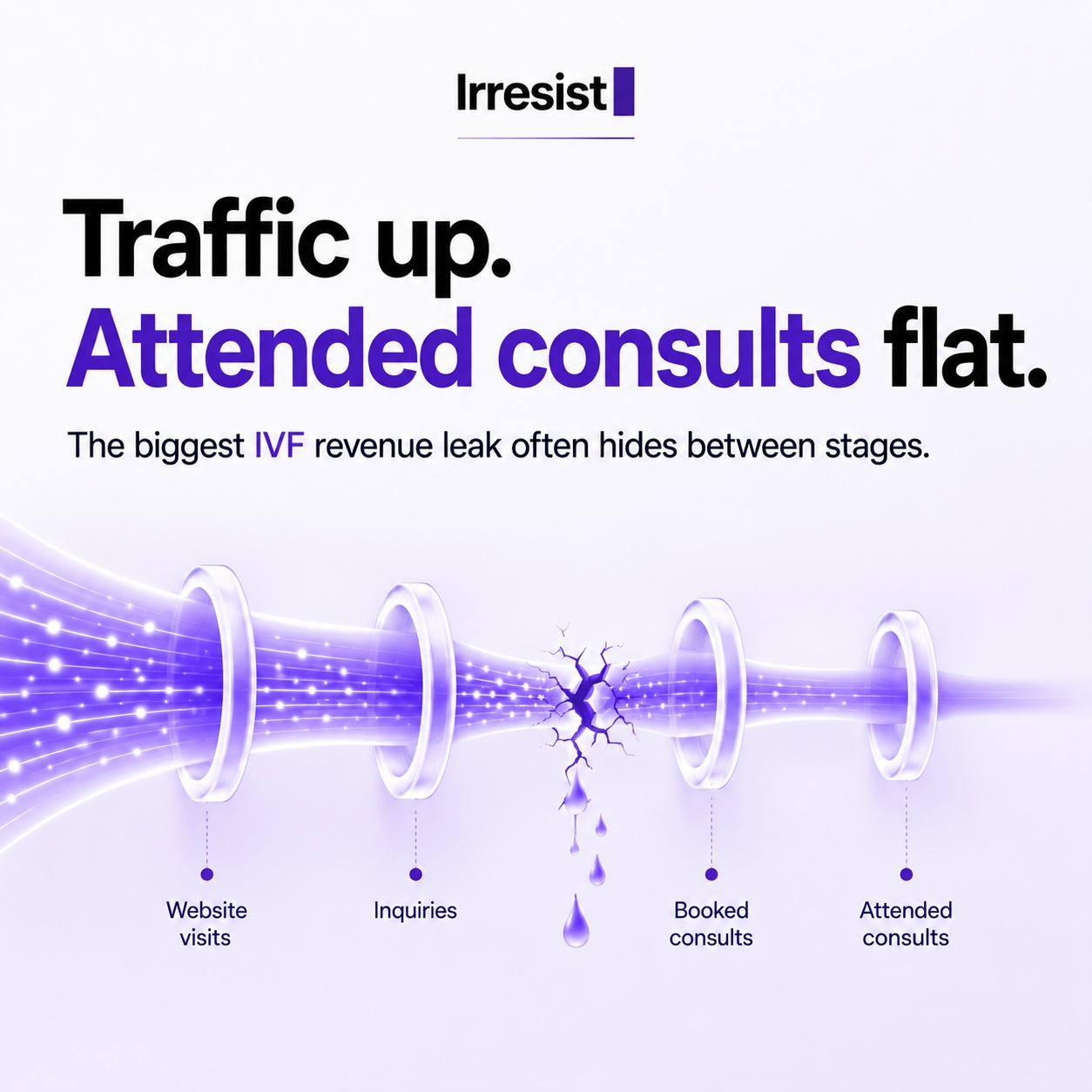
Your traffic looks healthy. Inquiries arrive. Yet booked and attended consults refuse to climb at the same pace, and when finance asks where the gap is coming from, no one can point to the exact spot where would-be patients slip away.
That gap has a name and a price. This article defines IVF patient leakage as a revenue problem, shows where it happens both before and after you capture a lead, and gives you a defensible way to size the impact without pretending to a precision the data can't support.
Key Takeaways
- Leakage is a revenue gap, not a traffic gap - It's the money lost when reachable patients drop out for avoidable reasons like friction, delay, and weak follow-up, rather than real clinical or personal ones.
- It hides in two places - Some patients leave silently before you ever see an inquiry; others stall after inquiry, between booking, attending, and deciding on treatment.
- The economics compound - Because a single IVF patient carries high lifetime value, small conversion gaps translate into large sums.
- More ads scale the leak - Buying traffic on top of a leaky funnel multiplies waste; fixing conversion first makes every future dollar work harder.
- Estimate a range, not a false number - Measure stage-to-stage movement, find the biggest drop, and model a modest, realistic lift.
What IVF Patient Leakage Actually Means in Business Terms
IVF patient leakage is the revenue a clinic loses when people who could have become patients drop out of the journey because of avoidable friction rather than genuine clinical or personal reasons. It's a commercial gap between the demand you attract and the revenue you actually capture.
That distinction matters because not every exit is leakage. A spontaneous pregnancy, medical ineligibility, or a considered decision not to pursue treatment are legitimate exits. Chasing those patients wastes effort. Leakage is the loss you could have prevented with a faster response, a clearer next step, or better routing.
The vocabulary shifts by audience, but the meaning holds. Whether you call it "fertility clinic conversion leakage," "IVF revenue leakage," or the broader category of "patient leakage healthcare," all three describe the same thing: reachable revenue that quietly leaves.
The cost becomes vivid at scale. Fertility treatment is one of the highest-value services in healthcare; a single IVF cycle costs between $5,000 and $25,000, many patients undergo multiple cycles, and with medication, genetic testing, frozen embryo transfers, and supplementary treatments, the lifetime value of a single fertility patient can exceed $50,000. When each lost patient can mean roughly that much in forgone lifetime revenue, small percentage gaps stop looking small. Preserving the intent behind each inquiry, something Irresist treats as core to intake, is where much of that value is either kept or lost.
Where Leakage Happens Across the IVF Journey
Leakage is rarely one leak. It's a chain of them, and the two halves behave differently enough that you should diagnose them separately. The clean dividing line is lead capture: losses before you ever see an inquiry, and losses after a lead is already in your system.
Before Lead Capture: High-Intent Visitors Who Leave Silently
Serious, ready patients often leave before your clinic sees any inquiry, so these losses never appear in your CRM. Common stuck points include:
- Proof and success rates buried far from the decision point
- Cost or financing pages with no clear next action
- Generic "contact us" CTAs that ask for effort without offering direction
- Heavy, multi-field forms that feel like paperwork
- Unclear paths on mobile, where much of this browsing happens
The driver underneath is emotional. When an anxious patient hits ambiguity about what happens next, that ambiguity reads as risk, and they leave to "research more," frequently without returning.
Treat these as hypotheses, not verdicts. Public pages can reveal likely drop points, but they can't prove how many patients left or why. Test the fixes; don't assume the losses.
After Lead Capture: Captured Leads That Stall
Capturing a lead is not the same as converting it. Revenue leaks between inquiry, booked consult, attended consult, and treatment decision. Typical after-inquiry leak points:
- Slow first response, since patients often book with whoever replies first
- Lost context between website and intake, so the first human reply is generic
- No clear owner for follow-up
- Consult no-shows
- Stalled or postponed patients who never get a structured recovery
It helps to separate the invisible revenue states so you can act on each one: contacted but not booked, booked but did not attend, attended but did not move forward, postponed, and lost with only a vague reason. Preserving context into intake and building a real recovery process for stalled patients are where most of this half of the leak gets closed.
How Leakage Drains Revenue, Staff Efficiency, and Growth Quality
Leakage costs more than the missed cycles themselves. It works on three fronts at once.
Revenue is the obvious one. Money spent on fertility marketing to generate traffic is wasted when that traffic doesn't convert, which quietly raises your effective cost per booked patient and drags down marketing ROI.
Staff efficiency erodes next. Unclear routing and lost context force intake teams to re-ask questions, chase cold leads, and rework follow-ups, spending effort on volume rather than movement.
Growth quality is the one that leaders underrate. Adding traffic on top of a leaky funnel scales the leak, not the revenue, so fixing conversion first is what makes future ad dollars work harder. That's the core of most clinic growth bottlenecks: the constraint is downstream of the ad, not in it.
The retention economics reinforce the point. According to Bain & Company's research, an increase in customer retention rates of 5 percent increases profits by 25 percent to 95 percent. The width of that range is the tell: it's a directional heuristic, not a precise measurement, and you should treat it that way.
A Framework for Estimating Leakage Impact Without Overclaiming
Here's a simple stage model you can run on your own numbers. The goal is a defensible range, not false precision. Define your movement stages, pull the count entering each one, calculate stage-to-stage conversion, find the single largest drop, then model what a modest, realistic lift at that one stage would mean in booked consults and revenue.
Keep the proof boundaries honest:
- Use cautious language throughout; these are estimates, not audited losses.
- Don't label stalled or postponed patients as lost revenue unless your own data proves it.
- Treat before-inquiry numbers as estimates, because the clinic never saw those visitors.
A quick illustration with round, clearly hypothetical numbers: say 10,000 monthly visitors produce 200 inquiries, 120 booked consults, 90 attended, and 40 treatment starts. The steepest drop sits between inquiry and booked consult. Lifting that one step from 60% to 70% adds roughly 20 booked consults a month before you touch ad spend. The method is the point; the figures are invented.
Action Priorities for Clinic Leadership
Think of this as a ranked list for leadership, not a task list for junior staff.
- Agree on shared journey-stage definitions - Make every location and team measure movement the same way, so you can compare performance fairly across a multi-site group.
- Fix the cheapest high-drop stage first - This is usually first-response speed and next-step clarity, and it's almost always cheaper than more ad spend.
- Preserve safe patient context - Carry intent from page to form to intake so the first human response is faster and more relevant.
- Build a structured recovery process - Handle stalled and no-show patients with a defined action tied to later movement, not old-lead blasts.
- Measure prospectively - Decide now which numbers you'll track going forward, so future decisions rest on your own data rather than industry averages.
Ready To Size Your Own Leak?
If you suspect revenue is leaking but can't yet point to where, that's the problem worth solving first. Irresist helps clinic leaders quantify and reduce leakage across the patient journey, inferring likely visitor intent, adding proof and route clarity, preserving context into intake, tracking forms, calls, and key actions, and validating uplift through controlled measurement. Request a private IVF Revenue Leak Map, and we'll map your likely drop points and identify the smallest high-impact fix to start with.
The Bottom Line
Leakage, not weak traffic, is usually the constraint on IVF growth, so your next move is to measure movement between stages before you approve another ad budget. Pull last quarter's numbers into the five-stage model above, find your single largest drop, and fix that one step first. You'll defend your marketing spend with cleaner math and recover revenue you're already paying to attract.
FAQ
What is IVF patient leakage?
IVF patient leakage is the revenue a clinic loses when potential patients drop out of the journey because of avoidable friction, delay, or weak follow-up rather than real clinical or personal reasons. It's a commercial gap between the demand you attract and the revenue you capture.
Is patient leakage the same as patient dropout?
Not quite. Dropout usually refers to patients leaving during treatment for clinical or emotional reasons. Leakage is the broader commercial loss across the whole journey, especially before treatment even begins, and much of it is preventable.
Where do IVF clinics lose the most patients?
Often at first-response speed and next-step clarity, since many patients book with whoever replies first and clearest. That's a pattern, not a guarantee, so verify it against your own stage-to-stage data before acting.
How can I estimate the revenue impact of leakage?
Use a stage model: measure conversion between each step, identify the single largest drop, then model what a modest, realistic lift at that stage would mean in booked consults and revenue. Aim for a range, not a precise figure.
Will more marketing fix patient leakage?
Usually not on its own. More traffic on a leaky funnel scales the leak and raises your effective cost per booked patient. Fixing conversion first makes every marketing dollar more efficient.
Can website data prove how much revenue we are losing?
No. Public and website data reveal likely stuck points and hypotheses worth testing, not proven losses. Proving actual revenue impact requires your clinic's own connected data across inquiry, booking, attendance, and treatment.