
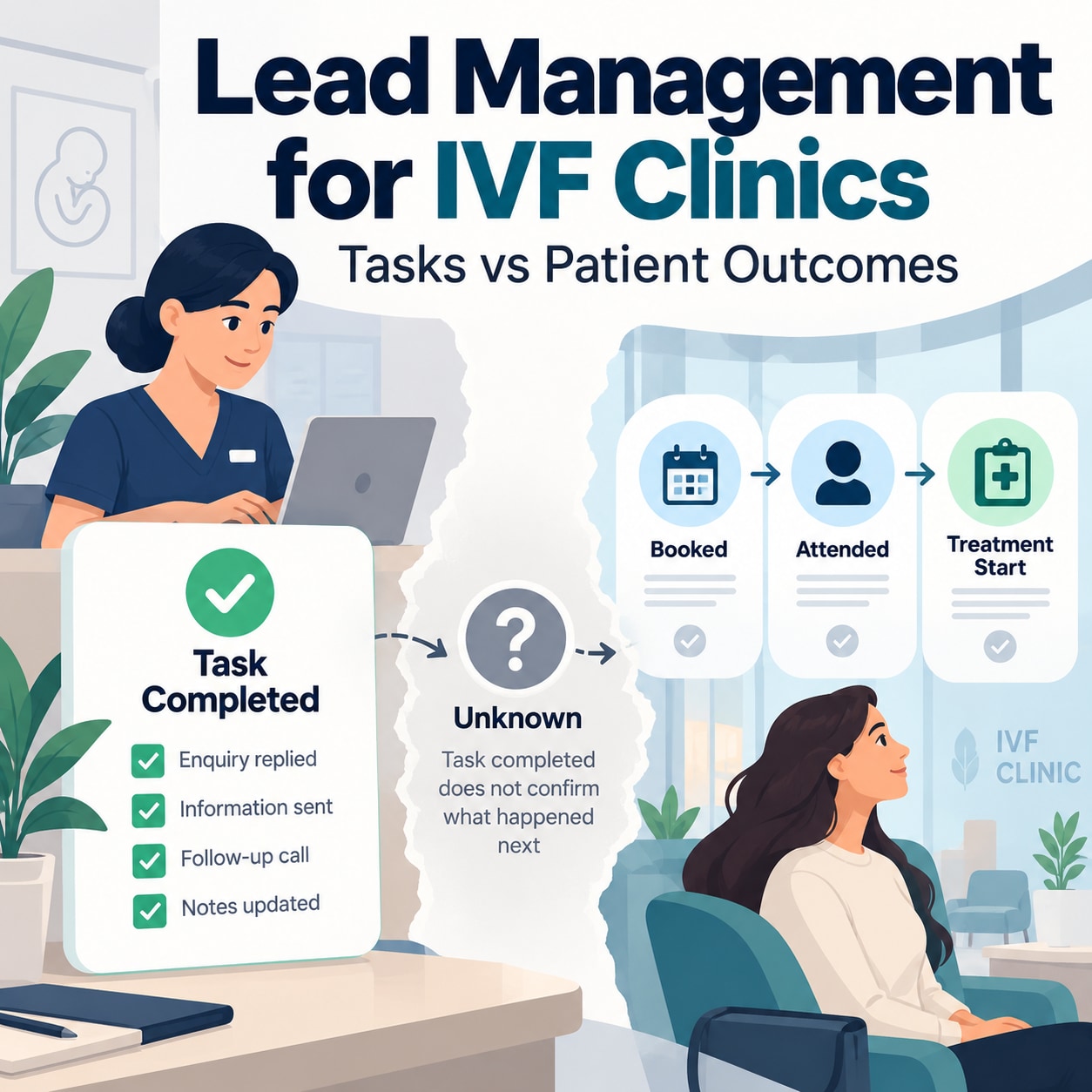
What IVF Clinics Need From Lead Management Software: Tasks vs Patient Outcomes
Effective lead management software for IVF clinics distinguishes between completed administrative tasks and verified lifecycle outcomes to ensure reporting accuracy. While a closed task confirms that a coordinator performed an assigned action, a verified outcome requires separate evidence such as a booked appointment or a treatment start to prove a patient journey actually progressed.
The callback task has a green check mark. The coordinator called, left a voicemail, and closed the task the way the workflow asks. Nobody can say yet whether the inquiry booked a consultation.
Lead management software for an IVF clinic has to handle that gap first. A completed task proves only that the task was marked complete under the workflow. A separately logged activity shows that an action was recorded. A separately verified lifecycle outcome shows what happened next. "Booking link sent" is an activity. "Consultation booked" is an outcome. Without an outcome or a valid closure reason, the result stays unknown.
In this article, a patient outcome means a verified commercial or operational lifecycle result: booked, attended, cancelled, postponed, no-show, lost with a valid reason, or treatment started. It excludes pregnancy, live birth, treatment success, embryo quality, prognosis, eligibility, and every other clinical outcome. Where the phrase could be read clinically, we use verified lifecycle outcome.
Why can a green check mark end the record too early?
The check mark proves the work item was closed under the workflow. It does not prove contact, booking, attendance, decline, or treatment start.
Task reporting can be accurate and still answer a different question from lifecycle reporting. The CRM recorded what it was asked to record, and the coordinator did the assigned work. The trouble starts when a closed task gets read as a closed journey.
What is the difference between a task, an activity, a stage, a verified outcome, and an unknown outcome?
These five facts each need their own evidence, timestamp, and source. Vendor vocabulary varies. Salesforce Help describes tasks and events as collectively called activities (checked October 26, 2026), so map your clinic's definitions onto the product's objects before assuming the words line up.
Task
A task is a unit of work assigned or due, such as call back, send information, or review a no-show. Completing it proves the task was marked complete under the workflow. It does not prove that the intended contact or patient result happened.
Activity or clinic action
An activity is a recorded clinic action, such as call attempted, message sent, voicemail left, or booking link sent. The log proves the action was recorded. It does not prove contact, a booking, attendance, or that the action caused later movement.
Lifecycle stage
A lifecycle stage is a shared business reading of where the inquiry sits, based on defined evidence. Good lead status management and lead lifecycle management require each stage to have a definition, a source, an effective timestamp, and a rule for handling unknowns before it appears in a report.
Verified operational outcome
A verified operational outcome is a separately recorded result: consultation booked, attended, cancelled, postponed, no-show, lost with a valid reason, or treatment started. These are operational results only.
Unknown outcome
An unknown outcome means no defensible later result is available as of a stated cutoff. It doesn't mean nothing happened, and it doesn't mean zero or lost. Any report label that uses "unknown" should carry an as-of date and a note on source coverage.
Why does every arrow in the inquiry-to-treatment chain require a separate fact?
No step proves the next one. Each arrow below needs its own observed or recorded fact.
missed call
-> callback attempt logged
-> contact made
-> consultation booked
-> consultation attended
-> treatment started
Here is the evidence that can support each step:
Missed call - A call-system record.
Callback attempt - An action log entry with a timestamp.
Contact made - A valid disposition or conversation result.
Consultation booked - An appointment identifier and date.
Consultation attended - An attendance result recorded after the due date.
Treatment started - A downstream operational event the clinic defines.
A tap on a website phone link only shows the link was used. You need call-system data to show that a call reached the clinic and whether anyone answered. If no callback appears in the connected history, report that coverage limit instead of guessing whether the callback never happened or simply wasn't captured. Good IVF inquiry management and follow-up tracking software keep these records apart.
The broader patient journey mapping guide for IVF clinics explains how to connect these events across systems. The three scenes below are illustrative.
Booking link sent, with no appointment yet
A coordinator sends a booking link and closes the task. The action is complete, but no appointment record has come back. The correct label is "booking link sent; booking outcome unknown as of October 26, 2026." Before closing the record, check every booking system and permitted route your process covers, because the person may have booked through one of them. An empty record can't explain why no appointment shows up.
No reply recorded as of a date
There have been two outreach attempts and no verified response as of the report cutoff. The correct label is "no reply recorded as of October 26, 2026." That is a different statement from "patient declined," "lost," or "never replied." This is how a no response lead status should work: the date keeps a current observation from turning into a claim about the future.
A verified missed call that still needs later events
The call system shows a missed inbound call, and a callback task is created. The callback, the contact, the booking, and attendance each need a new record. On its own, the missed call does not support a defensible revenue amount. The guide to fertility clinic revenue leakage explains that wider financial boundary. If a booking appears later, that still doesn't prove the callback caused it.
Which common lead-management category errors distort an IVF clinic's reports?
Each row below is a category error. The recorded fact can be true. The mistake is the conclusion someone draws from it.
| Recorded fact | Incorrect conclusion | Correct state | Evidence needed next |
|---|---|---|---|
| Message sent | Patient contacted | Clinic action recorded | Delivery and a valid contact result |
| Booking link sent | Consultation booked | Booking action offered | Appointment identifier and date |
| Callback attempt | Conversation happened | Attempt recorded | Answer or disposition |
| No reply as of a date | Lead lost | Outcome unknown, or a follow-up state set by policy | Verified closure or a later result |
| No-show | Final loss | No-show outcome for that appointment | Rebook, decline, later outcome, or valid closure |
| Task closed | Patient journey closed | Work item complete | A separate lifecycle outcome |
| Later booking after outreach | Outreach caused the booking | Action came before later movement | A stronger comparison before any causal claim |
Every row separates the recorded fact from a conclusion that still needs evidence. That is the practical difference between sales activity and outcome reporting.
Why is unknown a valid and useful state?
Unknown is a first-class reporting state with an as-of date and source coverage. It isn't a polite word for lost. Keeping it visible does several jobs:
It stops anyone from inventing loss reasons.
It separates data-quality gaps from patient behavior.
It shows where outcome updates are missing.
It lets a later event complete the history.
It keeps hindsight from rewriting the earlier record.
Unknown records are not an automatic outreach list. Before any later contact, check identity, authority, current status, duplicates, existing ownership, consent, and channel rules. Those rules depend on jurisdiction, clinic policy, contract, purpose, and implementation.
What should a decision-ready lead record preserve?
A useful lead record keeps action history apart from outcome history, and it keeps the raw source label apart from the canonical stage. Preserve these fields:
Record and source-system identifier
Location and service line
Raw source label
Canonical lifecycle stage, if mapped
Last verified clinic action, with timestamp and actor or system
Last verified lifecycle result, with timestamp
Current state: known, unknown, open, or mature
Any reason that was explicitly supplied, with its provenance
Next review date under clinic policy
Correction history
Data coverage or confidence
An inferred reason is not a recorded reason. Keep the last verified action and outcome as separate timestamps. A later booking must not overwrite an earlier unknown state or turn sequence into cause.
What should IVF lead management software display?
For an IVF clinic, lead management software should keep clinic actions and verified lifecycle outcomes as separate, dated facts, and it should leave unknown visible when the next result isn't in the connected record. The same split applies to patient outcome tracking and healthcare lead management more broadly. For IVF records, the display standard covers:
Separate timelines for actions and outcomes
A definition for every status and outcome
Both the raw and the mapped stage values
The last verified action and the last verified outcome, each with its own source and timestamp
Known, unknown, and open outcomes shown explicitly
A stale status kept separate from an open outcome
Valid recorded reasons kept separate from inferred explanations
Corrections that don't quietly rewrite history
Call, appointment, and downstream outcome coverage, including visible gaps
Export, auditability, and role and access controls that fit the deployment
A way to find records where the task is complete and the outcome is unknown
Some products already document separate concepts. HubSpot's current lifecycle-stage documentation describes Lead Status as sub-stages within the Sales Qualified Lead stage, with default options that include Attempted to Contact and Connected (checked October 26, 2026). Whether those values reflect reality depends on how each clinic configures and updates them.
What should a clinic ask a CRM or lead-management vendor?
Choose a system by whether it can report action dates and outcome dates separately, and by being clear about which system owns appointment and treatment-start truth. Ask:
Does closing a task change the lifecycle status automatically?
Can unknown stay a first-class state?
Do raw labels survive when stages are normalized?
Can the clinic see corrections and source provenance?
How does it tell missed calls apart from phone clicks?
Does the product infer reasons, or store only recorded ones?
Can records with a completed task and an unknown outcome be reviewed without bulk outreach?
Which owner, task, and status functions belong to the CRM, and which to an analytics or recovery layer?
How should weekly reporting expose completed tasks with unknown outcomes?
A weekly view should show completed work and unknown outcomes side by side, with the report cutoff date visible. The clinic sets its own thresholds and cadence. Views that are safe to make decisions from include:
Tasks completed this week
Successful contact outcomes
Booking links sent with no appointment returned
Missed calls with no verified next event
Booked appointments that are due, attended, cancelled, or no-show
Records older than a freshness window the clinic defines
Outcomes unknown as of the cutoff
Later movement after a logged recovery action
Later movement after a logged action shows sequence only. It doesn't prove the action caused the movement. Review the queue of completed tasks with unknown outcomes under clinic policy, and don't treat it as a list to contact.
Where can Irresist help, and which workflow still belongs to the clinic's source systems?
Irresist is a Fertility Patient Intelligence layer for IVF clinics. Where usable data exist, it can connect observable inquiry context, logged clinic actions, and later recorded lifecycle outcomes while keeping unknown and proof gaps visible. An early Revenue Recovery pilot can use manual or CSV outcome updates.
Irresist works alongside the CRM and other source systems where documented connections or exports, permissions, identifiers, availability, and quality allow. The fertility clinic CRM revenue recovery page explains that boundary; IVF lead follow-up software covers follow-up context; and Irresist's proof levels separate logged recovery from causal lift.
Irresist does not assign authoritative owners, replace the CRM task system, run the authoritative status workflow, or replace the CRM or EMR. It does not create outcomes the clinic never recorded, treat a phone click as a call, read no reply as rejection, prove causality from later movement, or know private intent, diagnosis, or clinical fit.
What this means for an IVF clinic
A clinic can trust its completed-task report and still lack the separate fact that says what happened next. A practical first step is to pull the records where the task is complete but the booking, attendance, closure, or treatment-start result is unknown as of the report date. Then check which source system owns each missing fact.
If you want an outside view first, request a private IVF Revenue Leak Map. It can show whether your biggest gap is the public patient path, status semantics, outcome freshness, phone coverage, or the recovery workflow after inquiry.
When a task turns green, can your clinic show the separate fact that tells you what happened next?
FAQ
What should lead management software track for an IVF clinic?
It should track clinic actions and verified lifecycle outcomes as separate, dated facts. That means call attempts, messages, and booking links on one timeline, and bookings, attendance, cancellations, no-shows, valid closures, and treatment starts on another. It should also keep raw source labels, mapped stages, correction history, and an explicit unknown state with an as-of date.
What is the difference between a completed task and a patient outcome?
A completed task shows that a work item was marked complete under the workflow. A patient outcome, in the operational sense used here, is a separately recorded lifecycle result such as consultation booked, attended, or treatment started. The task records the clinic's effort. The outcome needs its own evidence, timestamp, and source before anyone can report what happened next.
Does sending a booking link mean a consultation was booked?
No. Sending a link shows that the clinic offered a booking path. A booking needs a separate appointment record with an identifier and a date. Until one appears in a covered booking system, the correct label is "booking link sent; booking outcome unknown as of" the report date.
Should an IVF clinic mark a lead as lost after no reply?
Not automatically. "No reply recorded as of" a date is an evidence state that describes what the connected record shows right now. A lost status should need the closure evidence the clinic has defined, such as a recorded decline or a valid reason. Silence alone doesn't explain a person's decision and shouldn't rewrite their record.
How should missed calls and callbacks be recorded?
Record the missed call from call-system data, then log each callback attempt with a timestamp. Contact needs a valid disposition, and a booking needs an appointment identifier. A website phone-link tap is not a call record. If no callback appears, report the coverage limit instead of assuming no callback happened.
What lead statuses should a fertility clinic use?
Use statuses the clinic has defined, each with a definition, a source, an effective timestamp, and a rule for unknowns. Common operational outcomes include booked, attended, cancelled, postponed, no-show, lost with a valid reason, and treatment started. Keep action labels such as "attempted" apart from outcome labels, and keep unknown as a visible state.
Can a CRM show why an IVF inquiry did not become a patient?
Only when a valid reason and a later outcome were actually recorded. A CRM can show tasks, activities, and labels, but it can't infer a private reason from an empty field or from silence. Inferred reasons should never be stored or reported as recorded ones.
How can a clinic find leads whose tasks are complete but outcomes are unknown?
Filter for records with a completed task and no verified booking, attendance, closure, or treatment-start result as of the report cutoff. Show source coverage next to each record. Review the list under clinic policy, checking identity, current status, duplicates, ownership, consent, and channel rules before any follow-up.